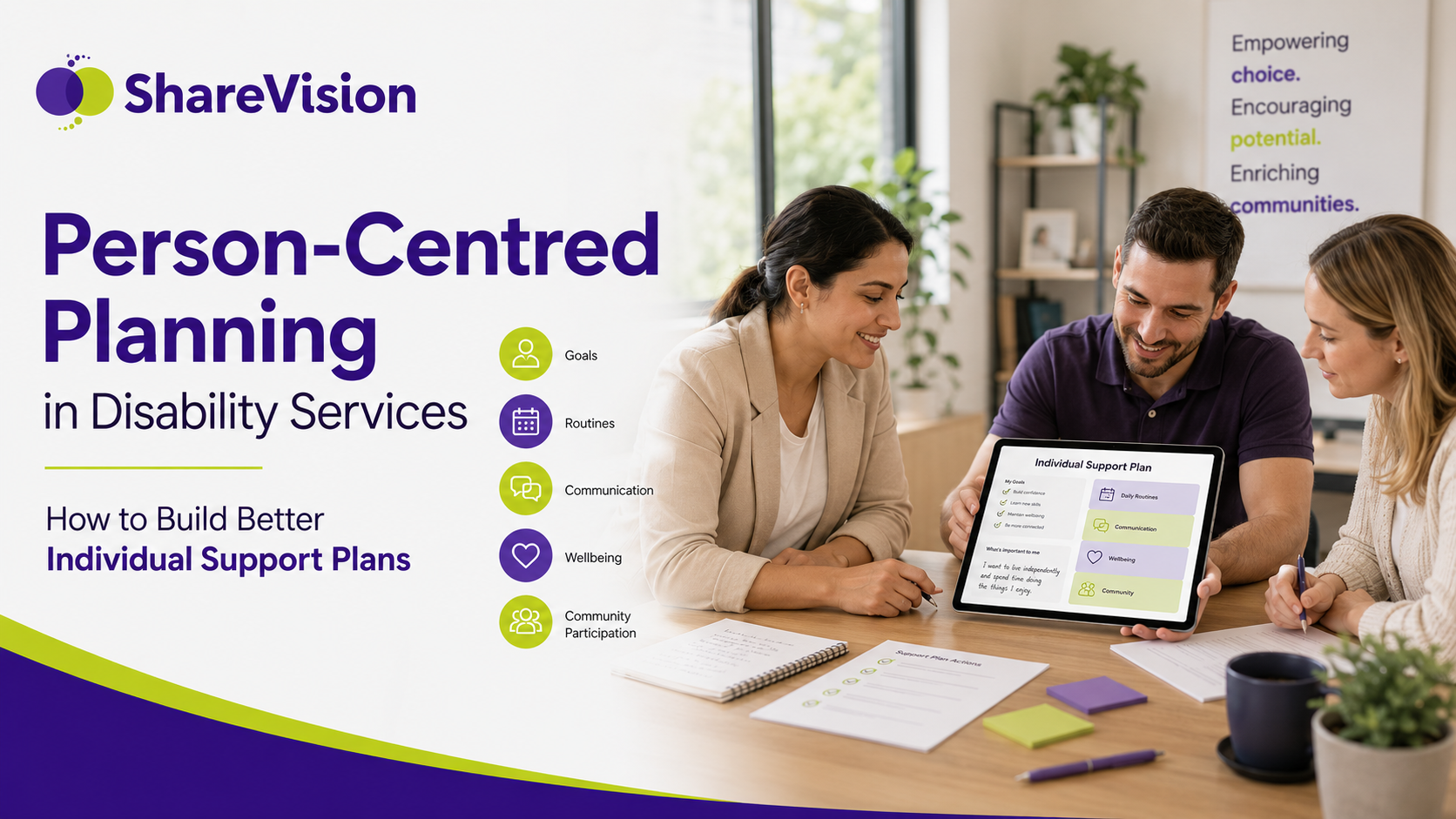
Person-centred planning puts the individual at the centre of their own support plan. Instead of building services around what an organization provides, staff start with the person's goals, preferences, strengths, needs and choices.
For organizations supporting people with developmental or intellectual disabilities, that sounds obvious.
Putting it into practice across dozens, hundreds or thousands of people is much harder.
Goals need to stay current. Frontline staff need access to the right information. Progress needs to be documented. Changes need to reach the right people. Supervisors need visibility. Families and support networks may need to participate. Organizations also need reliable records for reporting, funding, compliance and program evaluation.
When those pieces live across paper files, Word documents, spreadsheets, email and separate databases, a person-centred approach can quickly become a documentation problem.
A better system connects the individual's plan directly to the services and support they receive every day.
What Is Person-Centred Planning?
Person-centred planning is an approach to support that starts with the individual rather than the service system.
The goal is to understand:
- What matters to the person
- What they want to achieve
- What they enjoy
- What they want to change
- What support they need
- What choices they want to make
- Who is important in their life
- What risks or barriers need to be considered
- How staff can support greater independence and participation
A person-centred plan should not simply describe a diagnosis, list limitations or document the services an agency intends to provide.
It should help answer a more useful question:
What does a good life look like for this person, and how can their support team help them move toward it?
That changes the role of documentation.
Instead of creating a support plan because a form needs to be completed, the plan becomes something staff actually use to guide everyday decisions.
Person-Centred Planning Is Different From Traditional Service Planning
Traditional service planning can become organization-centred without anyone intending it to.
An organization has programs, schedules, staffing levels, forms and standard procedures. Over time, it becomes easy to fit people into those existing systems.
A traditional plan might focus on:
- Which program the person attends
- What time transportation arrives
- Which staff member is assigned
- Required medications
- Scheduled appointments
- Standard activities
- Required documentation
Those details matter.
But they do not necessarily tell you what the individual wants from their support.
Person-centred planning shifts the focus.
Instead of:
"John attends the employment program three days per week."
A person-centred goal might be:
"John wants to find paid work involving animals and build the skills needed to work independently."
The employment program is now part of the strategy, not the goal itself.
That difference matters because it gives staff something meaningful to work toward.
Individual Support Plans Should Connect Goals to Daily Support
Many developmental service organizations use an Individual Support Plan, often referred to as an ISP, personal support plan, care plan or individual plan.
Terminology varies between organizations and jurisdictions, but the basic purpose is similar.
The plan should create a practical connection between what the individual wants and what the support team does.
A strong individual support plan can include:
- Personal goals
- Strengths and abilities
- Communication preferences
- Daily routines
- Relationships and important people
- Community participation
- Employment or education goals
- Independent living goals
- Health-related support
- Behavioural support information
- Personal preferences
- Risks and safeguards
- Required accommodations
- Strategies staff should use
- Responsible team members
- Target dates
- Progress measures
- Review dates
The problem starts when these elements become disconnected.
Goals may exist in one document.
Daily notes are somewhere else.
Incidents sit in another system.
Appointments appear on a calendar.
Outcome reports are created manually in spreadsheets.
The organization technically has a person-centred plan, but the information needed to support it is scattered.
A Person-Centred Plan Should Be a Living Record
People change.
Their goals change.
Their circumstances change.
Their relationships, health, interests, confidence, skills and support needs can change.
An Individual Support Plan created once per year and stored as a PDF can become outdated long before the next scheduled review.
Person-centred planning works better when the plan functions as a living record.
Staff should be able to see:
- Current goals
- Recent progress
- Changes in support needs
- Relevant observations
- Upcoming milestones
- Recent incidents
- New preferences
- Tasks that require follow-up
- When the plan was last reviewed
This does not mean rewriting an entire plan every week.
It means creating a system where everyday service documentation contributes to a current picture of the person.
Start With What Matters to the Person
One of the most useful principles in person-centred planning is separating what is important to the person from what is important for the person.
Important to the person
These are things that contribute to happiness, comfort, identity and quality of life.
Examples might include:
- Seeing family regularly
- Going to hockey games
- Having coffee at a favourite café
- Spending time alone after work
- Choosing what to wear
- Having a pet
- Attending a faith or cultural community
- Playing video games
- Working outside
- Seeing particular friends
- Being involved in decisions
Important for the person
These relate to health, safety, support requirements and well-being.
Examples might include:
- Taking medication
- Attending medical appointments
- Following dietary requirements
- Using mobility supports
- Managing specific risks
- Receiving assistance with personal care
- Following a behavioural support strategy
- Maintaining a safe living environment
Good support considers both.
Focusing only on "important for" can create safe but highly restrictive services.
Focusing only on "important to" can overlook real health or safety needs.
Person-centred planning brings the two together.
Turn Broad Goals Into Goals Staff Can Actually Support
A common problem with Individual Support Plans is vague goal setting.
Consider:
"Become more independent."
That may reflect what the person wants, but it gives staff very little direction.
What does independence mean for this person?
It could mean:
- Taking public transportation independently
- Preparing breakfast without assistance
- Managing a weekly spending budget
- Going to a community activity without staff
- Making their own appointments
- Completing part of their morning routine independently
- Finding employment
- Moving into supported independent housing
The broader goal should be broken into observable milestones.
For example:
Goal
I want to travel to work on my own.
Milestones
- Learn the bus route with a support worker.
- Identify the correct stops.
- Practice paying the fare independently.
- Complete the trip with staff following separately.
- Complete the route independently.
- Review progress after 30 days.
Now the support team has something practical to work with.
Progress can also be measured without turning the person's life into a spreadsheet.
Track Progress Without Reducing People to Numbers
Outcome tracking matters in disability services.
Organizations need to know if their programs are helping people make progress.
Funders and leadership teams may also require measurable results.
But person-centred planning should not become a scoreboard.
A person's progress often involves context that a simple percentage cannot capture.
For example:
A person working toward greater community participation might attend only two activities during a month.
At first glance, that number may appear low.
But the case notes might show that six months earlier, the person would not leave their home because of severe anxiety.
Those two outings could represent significant progress.
Good disability outcome tracking combines structured data with qualitative documentation.
Organizations can track things such as:
- Goal status
- Milestones reached
- Frequency of participation
- Level of assistance required
- Skills developed
- Progress over time
- Staff observations
- Individual feedback
- Changes requested by the person
The numbers help identify patterns.
The notes provide context.
You need both.
Connect Daily Case Notes to Individual Goals
Frontline documentation is one of the most valuable sources of information in person-centred services.
Unfortunately, case notes often become isolated records.
A staff member writes:
"Went grocery shopping with Sarah today. She selected her groceries and paid at checkout with minimal prompting."
That note contains useful evidence about independence, decision-making and money-management skills.
If Sarah has an active goal related to independent shopping, the note should contribute to that goal.
When documentation and Individual Support Plans live in the same disability services software, organizations can create a much clearer connection between everyday support and long-term outcomes.
Instead of supervisors manually reviewing hundreds of notes, they can more easily see activity related to specific goals.
This also gives staff better context.
They can understand why an activity matters instead of treating it as another task on the schedule.
Give Frontline Staff the Information They Need
A support plan has limited value if frontline employees cannot easily use it.
Staff may work:
- In group homes
- In supported living environments
- At employment programs
- At community centres
- In respite services
- In day programs
- In clients' homes
- Throughout the community
They should not need to return to an office or search through a binder to understand someone's current goals.
Mobile-accessible disability services software can give approved staff access to relevant information from a phone, tablet or computer.
That can include:
- Active goals
- Support strategies
- Communication preferences
- Appointments
- Daily schedules
- Recent case notes
- Required forms
- Alerts
- Tasks
- Incident follow-up
- Individual preferences
ShareVision is browser-based and designed to work across mobile devices without requiring staff to install a separate application.
This can make person-centred planning part of everyday service delivery rather than something reviewed only during formal planning meetings.
Create One Record Across Multiple Programs
People often receive support from more than one program.
One individual may receive:
- Residential support
- Employment services
- Community participation support
- Behavioural services
- Respite
- Life-skills training
- Transportation support
Each program sees a different part of the person's life.
If every program maintains separate records, important context can disappear between teams.
A centralized I/DD case management software platform can give authorized staff a broader view of the person's services while still controlling access to sensitive information.
That helps organizations coordinate support around the individual rather than around departmental boundaries.
For example, employment staff may document progress in workplace communication.
Residential staff may notice the same person beginning to communicate needs more confidently at home.
Together, those observations tell a stronger story about progress than either program sees alone.
Build Support Around Choice and Self-Determination
Person-centred planning is closely connected to choice and self-determination.
That means the person should have meaningful input into decisions about their own life.
Depending on the person's needs and communication style, participation may look different.
It can include:
- Choosing goals
- Ranking priorities
- Choosing between activities
- Selecting preferred support strategies
- Identifying who participates in planning meetings
- Reviewing their own progress
- Asking to change a goal
- Declining a proposed activity
- Choosing how information is communicated
Some people communicate verbally.
Others may use communication devices, visual tools, gestures, behaviour, family input or other methods.
The planning process should adapt to the person rather than expecting the person to adapt to the planning process.
Include Families and Support Networks Appropriately
Families, guardians, friends, advocates and other members of a person's support network can provide valuable information.
They may understand:
- Personal history
- Communication patterns
- Long-term preferences
- Medical needs
- Relationships
- Past experiences
- Cultural considerations
- Signs of stress or discomfort
Their involvement can strengthen planning.
At the same time, person-centred planning keeps the individual's preferences at the centre whenever possible.
The support network contributes to the plan.
It should not automatically replace the person's voice.
Organizations also need clear permission and access controls around who can see sensitive information.
Use Reviews to Ask Better Questions
An annual ISP review should not simply ask:
"Did we complete the form?"
A useful review asks:
- Is this still something the person wants?
- What progress has been made?
- What changed?
- What worked?
- What did not work?
- Does the person need different support?
- Are staff following the agreed strategy?
- Has the person developed new interests?
- Have new barriers appeared?
- Is this goal still meaningful?
- Should the goal change?
- Is the current level of support still appropriate?
Digital reminders can also help teams identify plans that require review before deadlines pass.
Managers can see upcoming reviews instead of depending on separate calendars or staff memory.
Connect Incident Information to the Bigger Picture
Incident reporting and person-centred planning should not operate in isolation.
An incident can sometimes reveal information about:
- Stress
- Environment
- Communication
- Changes in routine
- Support levels
- Triggers
- Health
- Relationships
- Transportation
- Staffing
- Community participation
A single incident may not indicate a pattern.
Repeated incidents might.
If incident data, case notes and individual plans can be viewed together by authorized staff, supervisors have better information for reviewing support strategies.
The purpose is not simply to document what happened.
The organization can use the information to ask what might need to change.
Person-Centred Planning Across Residential Services
Person-centred planning becomes especially important in residential and community living services because support affects so many parts of everyday life.
Traditional residential documentation can easily become focused on operational tasks:
- Meals completed
- Medication administered
- Cleaning completed
- Appointments attended
- Shift notes submitted
Those tasks matter, but a home is still someone's home.
Person-centred residential support should also consider:
- Who the person wants to spend time with
- How they decorate their space
- Preferred routines
- Privacy
- Food preferences
- Community activities
- Personal relationships
- Independence
- Household responsibilities
- Future housing goals
Good documentation captures support needs without allowing administrative routines to become the centre of the person's life.
Person-Centred Planning in Employment Services
Employment programs provide another strong example.
The organizational goal might be employment placement.
The person's goal may be much more specific.
They may want:
- A job involving animals
- Part-time work rather than full-time work
- Employment close to home
- Work that does not involve customer interaction
- A role with predictable routines
- A workplace accessible by public transportation
- Greater independence from a job coach
- Enough income to reach a personal financial goal
Tracking only "employed/not employed" misses much of that context.
A person-centred employment plan can track the outcome alongside the individual's preferences and progress toward sustainable employment.
Why Spreadsheets Make Person-Centred Planning Harder
Spreadsheets can handle lists.
They struggle when relationships between information become complicated.
For example, one client may have:
- Five active goals
- Three services
- Seven staff members
- Multiple assessments
- Dozens of monthly case notes
- Appointments
- Incidents
- Family contacts
- Progress reviews
- Required forms
Multiply that by 200 clients.
Organizations often end up creating separate spreadsheets for separate tasks.
Soon staff are asking:
- Which file is current?
- Who updated this?
- Where is the latest plan?
- Has this goal been reviewed?
- Did anyone follow up?
- Which staff member has the newest information?
This is one reason organizations move from spreadsheets and paper records to purpose-built developmental disability software.
The goal is not simply digitizing forms.
It is connecting the information around the person.
What to Look for in Person-Centred Planning Software
If your organization is evaluating person-centred planning software, look beyond basic client records.
The platform should support the way your organization actually delivers services.
Useful capabilities include:
Individual client records
Maintain a central record containing the information authorized staff need.
Goal tracking
Create individual goals, milestones, target dates and progress records.
Custom forms
Different organizations use different planning models. The software should adapt to your forms rather than forcing your services into one rigid template.
Case notes
Document everyday services and observations while connecting documentation to the broader client record.
Outcome tracking
Track individual progress and program-level outcomes.
Program management
Manage people receiving multiple services without creating disconnected records.
Mobile access
Let frontline staff document and review information while working in homes and throughout the community.
Reminders and notifications
Prompt staff about reviews, follow-ups, forms and other required actions.
Role-based permissions
Give employees access based on their responsibilities.
Reporting
Create reports for supervisors, leadership teams, boards and funders without rebuilding information manually.
Audit history
Maintain a record of documentation and updates.
Incident management
Track incidents, follow-up actions and relevant patterns alongside the person's broader support record.
How ShareVision Supports Person-Centred Disability Services
ShareVision is case management and nonprofit CRM software built for organizations delivering human and social services.
For developmental and intellectual disability organizations, ShareVision can bring client information, support plans, goals, documentation, services and reporting into one platform.
Organizations can use ShareVision to:
- Create individual client records
- Set and track client goals
- Build custom forms and checklists
- Record progress
- Manage programs and services
- Track outcomes
- Complete documentation from mobile devices
- Manage incident information
- Create reminders and notifications
- Control access by user role
- Generate custom reports
- Track services across different programs
Because the platform is configurable, organizations can build workflows around their own terminology, programs and planning processes instead of replacing their model with a generic CRM structure.
From Documentation to Better Support
The best person-centred planning system is not the one with the longest Individual Support Plan.
It is the one staff actually use.
A good system helps everyone understand:
What matters to this person?
What are they working toward?
How are we supporting that goal?
What progress are we seeing?
What needs to change?
When those answers are buried across paper files, spreadsheets and disconnected systems, person-centred planning becomes harder than it needs to be.
When the information is connected, the Individual Support Plan can become part of everyday service delivery.
That gives frontline staff better context, managers better visibility and organizations better information about the outcomes their services are producing.
Most importantly, it keeps the focus where it belongs: on the person receiving support.
Build Person-Centred Support Around the Individual, Not the Software
Every disability service organization works differently.
Your programs, terminology, reporting requirements, forms and planning processes may be different from the organization down the street.
Your software should support those differences.
ShareVision gives developmental disability, intellectual disability and community living organizations a configurable platform for managing client information, Individual Support Plans, goals, outcomes, documentation and service delivery in one place.
Want to see how ShareVision can support person-centred planning in your organization?
Book a ShareVision demo and see how your existing planning and documentation processes can work in one connected system.
Frequently Asked Questions About Person-Centred Planning
What is person-centred planning in disability services?
Person-centred planning is an approach that organizes support around an individual's goals, preferences, strengths, needs and choices. The person receiving support participates in setting the direction of their plan rather than having services determined only by available programs.
What is an Individual Support Plan?
An Individual Support Plan, or ISP, documents a person's goals, preferences, support requirements, strategies, responsibilities and expected outcomes. Organizations may use different names, including personal support plan, individual plan or plan of care.
What should be included in a person-centred plan?
A person-centred plan can include personal goals, strengths, communication preferences, relationships, community participation, employment, independent living, health needs, risks, support strategies, milestones and review dates.
How do you measure person-centred outcomes?
Organizations can combine measurable indicators such as milestones, participation, skill development and level of assistance with case notes, observations and feedback from the individual. This provides context that numbers alone may miss.
Can case management software support person-centred planning?
Yes. Disability case management software can connect Individual Support Plans, goals, case notes, outcomes, forms, incidents, services and reporting within one client record. This makes the plan easier for frontline staff and supervisors to use throughout service delivery.
What is person-centred planning software?
Person-centred planning software is a digital system used to create, manage and review individualized support plans. Purpose-built platforms may also include goal tracking, case notes, outcome measurement, incident reporting, program management and reporting.
Can ShareVision track individual client goals?
Yes. ShareVision supports individual client goal tracking, progress plans, custom forms, checklists, outcome tracking and reporting within its case management platform.
Is ShareVision designed for developmental disability organizations?
ShareVision supports social service agencies including developmental disability, intellectual disability, community living, residential care, employment support and other human service organizations.