Why AI matters for fundraising capacity
AI is rapidly becoming a standard tool inside nonprofit development teams. It’s not replacing fundraisers — it’s removing the bottlenecks that slow them down. Most teams aren’t short on donor goodwill. They’re short on time, clarity, and the ability to act on donor insights fast enough.
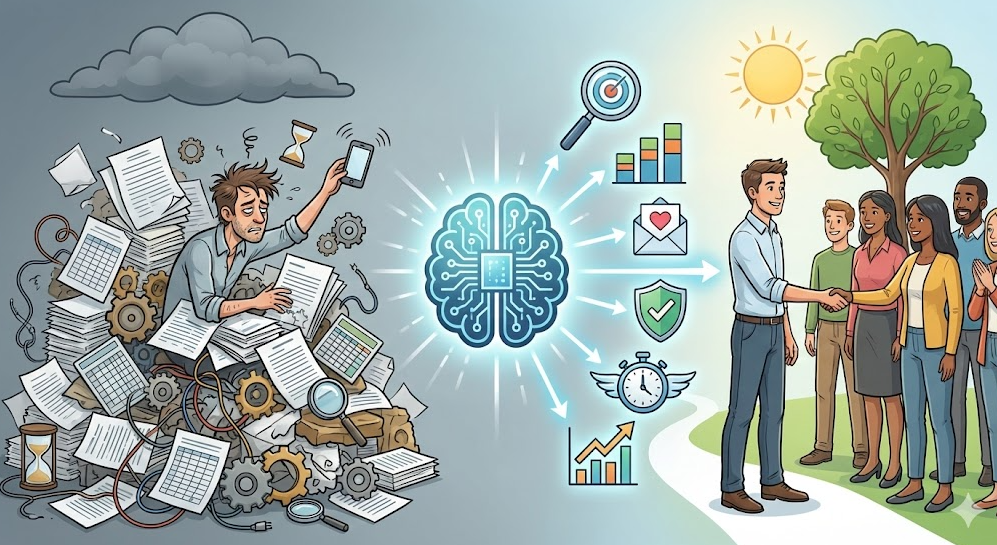
Fundraisers spend an enormous amount of energy sorting through spreadsheets, juggling CRMs, trying to decide who to contact next, or manually preparing outreach. AI handles that load in the background. That shift creates space for the work that actually drives revenue: conversations, relationships, stewardship, and clear asks.
AI gives you more capacity without adding headcount, which is why more organizations are building it directly into their development workflows.
What AI can do for your fundraising team
1. Predict who’s likely to give
Predictive modeling highlights donors who are most likely to give again, increase their gift, or respond to a specific campaign. Instead of guessing, you get a ranked list of high-probability donors. That lets you direct your time toward people who are already primed for connection.
2. Segment donors automatically
Traditional segmentation takes hours. AI does it instantly. It groups donors by giving patterns, capacity signals, communication behaviour, and interests. That makes every campaign more targeted and every message more relevant.
3. Personalize outreach at scale
AI can draft first-pass messages, thank-you notes, campaign reminders, and tailored updates that fit each segment. Your team then edits, adds context, and sends. This keeps communication warm and frequent without burning staff time.
4. Reveal donors at risk of lapsing
AI can flag donors showing early signs of disengagement. A quick call, email, or personal update can often pull someone back before they disappear permanently.
5. Speed up data analysis
Campaign results, donor journeys, event performance — AI processes the entire picture in minutes. You get clear patterns, fast. That frees your team to adjust in real time instead of after the fact.
6. Handle foundation-level tasks automatically
Reporting, data cleanup, deduplication, follow-up reminders, donor profile enrichment — AI tackles these unglamorous tasks that normally drain hours. That reclaimed time becomes development time.
The value nonprofits are already seeing
More donor engagement
When you prioritize the right donors and speak to them with the right message, engagement goes up. Organizations using AI-driven segmentation tend to see higher open rates, click-throughs, and giving responses.
More revenue
Better targeting usually leads to higher conversion rates and more consistent giving. Some teams see double-digit growth because they can finally act on data they’ve had for years but couldn’t process.
Lower donor churn
Lapse-prevention alerts make stewardship proactive instead of reactive. The earlier you re-engage someone, the easier it is to keep them.
More strategic capacity
AI frees teams from the busywork that keeps them from major gifts, personal calls, stewardship meetings, and donor cultivation — the activities that actually move revenue.
What you need in place before using AI
Clean data
AI can’t fix bad data. Duplicate records, missing history, untagged donors, and inconsistent notes create bad predictions. A simple cleanup project dramatically improves AI accuracy.
Clear goals
Start with a question you want answered:
- Who’s likely to give before year-end?
- Which lapsed donors are worth reaching out to?
- Who might be ready to upgrade to monthly giving?
When the goal is clear, the AI outputs are easier to use.
Human oversight
AI is a tool, not a replacement for relationship work. Your team still makes the decisions, crafts the tone, and builds trust with donors.
How to roll out AI inside your nonprofit
Step 1: Clean and organize your data
Fix duplicates, fill in missing data, and tag donors consistently. Better data equals better predictions.
Step 2: Choose one use case to pilot
Start small: donor likelihood scoring, segmentation automation, or personalized messaging drafts. One workflow is easier to measure and refine.
Step 3: Train staff on how to interpret outputs
The real value isn’t the AI result; it’s how your team uses it. Build a simple process:
- Review the insights
- Prioritize the top donors
- Personalize outreach
- Log results
- Review outcomes monthly
Step 4: Expand to other fundraising areas
Once the pilot works, layer AI into stewardship, events, campaigns, volunteer engagement, grant follow-ups, or major gifts research.
Step 5: Measure outcomes
Track what changes:
- Response rates
- Average gift size
- Hours saved
- Donors retained
- New prospects surfaced
This creates the business case for long-term investment.
The bottom line
AI doesn’t replace the human side of fundraising. It amplifies it. It automates the work that drains time so your team can spend more energy in conversations, stewardship, relationship-building, and meaningful asks.
The nonprofits using AI best are the ones treating it as a capacity tool — not a shortcut. They let AI handle the foundation so they can focus on connection.